Note
Click here to download the full example code
From SAB Dataset to Decoding
This example shows how to use the different modules of SAB_main from the creation of the SAB Dataset to decoding EEG
# import matplotlib
# matplotlib.use('TkAgg')
import sab_dataset
from timedecoder import *
from sklearn import svm
import os
import seaborn as sns
sns.set()
sns.set_context('paper')


sab_dataset_dirpath = os.path.join('pySAB', 'sample_data') if os.path.isdir('pySAB') else os.path.join('..', '..', 'pySAB', 'sample_data')
sab_dataset_filename = 'sab_dataset_rec_subject_id_040119_1153.p'

load_dataset = 1
Dataset creation from the matlab dataset This first step create the python dataset of the SAB data from the matlab dataset. All is needed is the path towards the matlab dataset directory and the id of the subject. The matlab directory must contain the variables EEGrec.mat, hits.mat, correctRejects.mat, falseAlarms.mat, omissions.mat, reactionTimes.mat
if not load_dataset:
    sab_dataset = sab_dataset.SabDataset(sab_dataset_dirpath, 'subject_id')
    ###########################################
    # If you want to specify colors for the different conditions, use the color_dict argument. It must be a dictionnary
    # with the condition names as keys and the colors as values. For instance :
    # sab_dataset = sab_dataset.SabDataset('path_to_the_matlab_directory', 'subject_id',
    #                          colors_dict={'hits': 'g', 'cr': 'r', 'omission': 'y', 'fa': 'm'})
    # To save the newly created dataset use the save method which takes 2 arguments : the directory where the dataset
    # will be saved and the filename. By default the filename will be similar to sab_dataset_rec_001AA_150218_1542.p
    sab_dataset.save('path_to_save_the_dataset', 'sab_dataset_name.p')
else:
    ###########################################
    # If you have previously created the dataset, you can load it using the load_sab_dataset function. The function
    # takes as argument the path of the file
    sab_dataset = sab_dataset.load_sab_dataset(os.path.join(sab_dataset_dirpath, sab_dataset_filename))
You can print the informations of the dataset using the print function
print(sab_dataset)
Out:
SAB dataset REC - subject_id
7 channels, 359 points [-0.10, 0.60s], sampling rate 512.0 Hz
356 trials : 183 hits, 173 correct rejects, 0 omissions, 0 false alarms
Channel Info : 7 channels and 1 electrodes
7 EEG channels - 0 non-EEG channels
1 EEG electrodes - 0 non-EEG electrodes
If needed you can downsample the data using the downsample method.
help(sab_dataset.downsample)

# Downsample the dataset to 256Hz
sab_dataset.downsample(2)
Out:
Help on method downsample in module sab_dataset:

downsample(decimate_order) method of sab_dataset.SabDataset instance
    Downsample the data along the time axis.

    Parameters
    ----------
    decimate_order : int
        Order of the down-sampling. Sampling frequency will be divided by this number

New sampling rate is 256.0
TimeFeature Creation from the sab_dataset For this step you just need to call the create_features method of SabDataset class which returns a TimeFeature instance
time_features = sab_dataset.create_features()
It is possible to select some channels, electrodes or trials using respectively the chan_sel, electrode_sel or trial_sel arguments. See the help for more details :
help(sab_dataset.create_features)
Out:
Help on method create_features in module sab_dataset:

create_features(chan_sel=[], electrode_sel=[], trial_sel=[]) method of sab_dataset.SabDataset instance
    Create a TimeFeatures instance from the current dataset

    Parameters
    ----------
    chan_sel : int | str | array | None (default: None)
        Channel selection to compute the feature only on these channels. If none, select all channels
    electrode_sel : int | str | array | None (default: None)
        Electrode selection to compute the feature only on these electrodes. If none, the selection is done based
        on ``chan_sel`` parameter
    trial_sel : array | None (default: None)
        Trial selection to compute the features only with these trials. If none, select all trials

    Returns
    -------
    TimeFeatures : Instance of TimeFeatures
        TimeFeatures instance generated from the amplitude of the current dataset, given the selected channels

    .. note:: If both chan_sel and electrode_sel are provided, the selection is only done given the electrode
    selection
You can check the time_features information using again the print function
print(time_features)
Out:
Time Features subject_id_rec - 7 features, 180 time points, 356 trials
2 labels : {1: 'Hits', 2: 'Correct rejects'}
Feature types : Amp
TimeDecoder Class. In this step, the time_decoder instance is created from the TimeDecoder class. This class allow to run classification on the time_features data. First we need to created a classifier to the time_decoder instance. It can be Support Vector Machine, LDA, … as long as it support 2-classes classification with fit and predict methods In this example, we use a SVM classifier, with C parameter set to 1
svm_clf = svm.SVC(kernel='linear', probability=True)

# We can now create the time_decoder instance.
time_decoder = TimeDecoder(svm_clf)
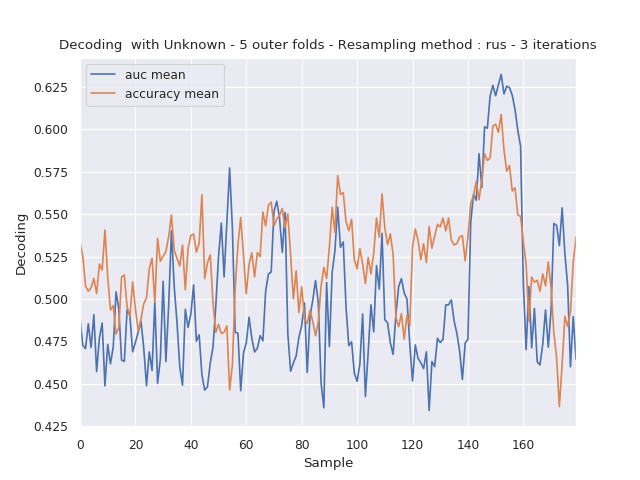
Decoding. We can now start to classify the EEG data (stored in time_features), given 2 conditions (e.g. ‘hits’ and ‘Correct rejects’) by using the decode method.
data, _, labels, _ = time_features.get_data(label_keys=[1, 2])
# label_keys 1, 2 are the labels used for hits and correct_rejects respectively. You can see it with the label_dict argument
print(time_features.label_dict)
# Run the decoding using multiples processors :
scores = time_decoder.decode_mpver(data, labels, time_features.label_dict)
Out:
{1: 'Hits', 2: 'Correct rejects'}
183 Hits - 173 Correct rejects
Function : decode_mpver - Time elapsed : 8.572508335113525
You can select data using the arguments of get_data method (see help(time_features.get_data)). The possible selection arguments are feature_pos, feature_type, feature_channame, label_keys and time_points. The current time_features instance contains the following channels :
print(time_features.channel_names)
Out:
["EEG TP'1-TP'2" "EEG TP'2-TP'3" "EEG TP'3-TP'4" "EEG TP'4-TP'5"
 "EEG TP'5-TP'6" "EEG TP'6-TP'7" "EEG TP'7-TP'8"]
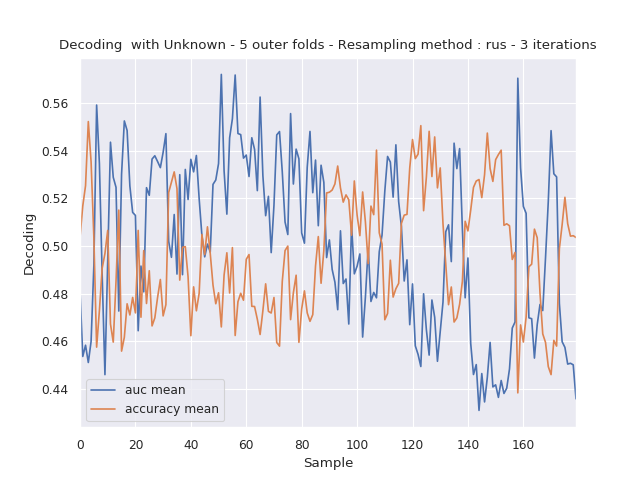
If we want to select only some channel, you can specify it with the feature_channame argument :
data, _, labels, _ = time_features.get_data(feature_channame=['EEG TP\'2-TP\'3'], label_keys=[1, 2])
scores = time_decoder.decode_mpver(data, labels, time_features.label_dict)
Out:
183 Hits - 173 Correct rejects
Function : decode_mpver - Time elapsed : 6.56610631942749
Total running time of the script: ( 0 minutes 16.514 seconds)